
Eimear Burke on Druidry
Tsubaki Shinto Shrine in U.S. to Close
You might think this post falls in the category of local and religious news more than anything specific to Druidry. But it’s relevant for several reasons. Shinto is an earth-spirituality of Asian origin that focuses much of its energies on shrines, and it has subtle and profound things to teach at least some of our Western manifestations of the same impulses. Shinto also has scant visibility in North America outside of Hawaii — such a closing has an outsized effect on practitioners of Shinto. It also reduces further the chance for Westerners to encounter another spirituality based in experience and practice rather than creed and belief. The news is further worth attention because the founder of the shrine is one of the few non-Japanese Shinto priests. His retirement brings 30 some years of access to this particular and lovingly maintained shrine to a close.
A recent Seattle Times article (April 2023 — “How one of the country’s largest Shinto shrines ended up in tiny Granite Falls”) includes stunning photos of the shrine, and gives good background about both the circumstances of its founding and closing.

I’ve written here and here about Shinto, and here about visiting Tsubaki shrine myself a decade ago. Places where Druids live and practice merit consideration for Druid shrines. As I observed in a previous post,
Site stats show that my previous posts on Shinto are among the most popular here at A Druid Way. The reason for that can’t be too far to find. We crave like a food-hunger a spiritual reality that does not depend on belief (or at least not on belief alone), but is present to us whenever we’re present to it — and even when we’re not. We may hunger for a Way or Ways, just like we yearn for dark chocolate or hot sauce or beef or fresh limes in guacamole (insert your favorite food hunger here), a harmony that we can begin to fall back into at any moment, wherever we are, just by shifting our attention, and restore a sense of balance and integrity. And not just a sense of them, but its reality — a poise for living that shows in our words and deeds. We’ve all known this harmony, witnessed it in others, however briefly, which is why we can feel so disheartened when we lack it, when we’ve lost it, fallen out of it. We know it’s possible because it’s there, in living memory, however far we seem to stand from it right now, in this often grubby, muddy present moment.
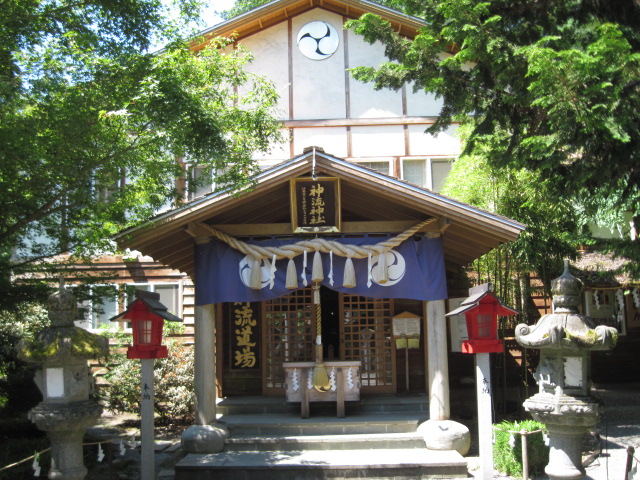
“Shrine Druidry” happens subtly and ritually every time a Druid works with inner and outer groves, holds a ritual, honors the spirit of the landscape, and so on. While large public shrines like Tsubaki or Spirit in Nature are lovely and accessible public inspirations, bringing many into an encounter with alternative ways of being and doing and moving in the world, at least as important is my daily practice, because it IS daily, rather than an occasional visit to another place. Too easily we discount the ripple effect each of us carries with us in our interactions with others, those wearing fur and flesh, bark and feathers, and those who do not.
/|\ /|\ /|\
Review of Dana O’Driscoll’s “TreeLore Oracle” and “A Magical Compendium of Eastern North American Trees”
Longtime readers of this blog know of Dana O’Driscoll’s splendid work as permaculturist, author, artist, Archdruid of AODA, blogger at The Druid’s Garden and dedicated “walker of her talk”. It’s a pleasure to explore the rich harvest of this deck and companion book she has illustrated with her own eco-prints, and as importantly, put it to work in my own practice. [You can view images of every card, read more about this 12-year project, and find ordering information here at her blog: https://thedruidsgarden.com/treelore-oracle ]
Direct and to the point, O’Driscoll sets forth the purpose of the Oracle and Compendium in her Introduction:
One of the most important things we can do to address the challenges of today’s age is to build authentic, lasting and meaningful nature-based spiritual practices that are localized to our own ecosystems. We can build deep connections with that land and take up our traditional ancestral role in tending and honoring nature. The nature-based spiritual, divinatory, and magic practices we use are more meaningful if they are rooted in our local ecosystems (pg. 7).
A relationship with the trees of one’s home region is a pre-eminent Druid practice. This gorgeous oracle deck invites both touch and meditation, which if I reflect for another moment is another kind of touch, but with the inward senses. The trees in my yard that I know and work with — black walnut, mountain ash, hemlock, white pine, various oaks — connect with me in ways that Dana’s book highlights for each of the 35 species she covers here. And with the tools she provides, you can extend your work with your own local trees, using the techniques she suggests for your own locale.
The Compendium’s subtitle expands on the material O’Driscoll offers readers here — “Ecology, History, Lore and Divination”. But the author is no ideologue, and finds her own wisdom to share:
One important thing to note is that trees — just like people — have multiple faces and aspects of personality. Thus, a single tree can hold different and sometimes contradictory meanings and no tree represents only one thing … I think it’s useful to consider tree personalities like a person: each person you meet has different sides: perhaps their work persona, the person they are with their closest friends, the person they are with their family, themselves as a parent, and so forth. Many of the trees are like this — they are multifaceted. They may choose to show you different meanings than I have, and that’s OK (pg. 11).
While anyone can deploy the Tree Oracle as a stand-alone divination deck, making deep use of the companion Compendium allows for a multitude of different ways to literally internalize the wisdom that a divinatory spread offers a querent. With recipes, crafts, symbolism, history and more, a reader can work towards profound connections with “neighbor trees”. We eat the nuts from the Black Walnut in our back yard, sharing bags of nuts with friends, watching the rhythms of the tree in productive and spare years. We use the oils to preserve wood surfaces, enjoy the red and black squirrels contending for their share of the nuts, learn more about other moisture-loving trees nearby (like our old willow, at least 100 years old) who aren’t put off by the infamous juglone the walnut secretes to regulate its own environment and drive off pests. We connect with our magical mountain ash in our front yard, which puts on a show in every season, flowering white each spring, fruiting in summer, turning bright red in autumn, and feeding birds in winter. I gather fallen and dead twigs, with permission, and craft them as ogham staves for friends. And I’m learning to make songs to sing to my trees, as one among many ways to connect, with new themes that O’Driscoll’s oracle and compendium suggest.
Resistance and Flow
[ 7 | 8 | 9 | 10 | 11 | 12 | 13 | 14 | 15 | 16 | 17 | 18 | 19 | 20 | 21]
A curious dampening has beset me since I began this series. I find writing useful for so many reasons, and as a spiritual barometer it’s priceless. Things I didn’t realize were rumbling beneath the surface come into awareness when I write. Rather than always worrying at (or about) a topic, I start talking, and momentum almost always delivers something to say. You’d think that armed with that experience I’d easily complete a series like this, or a minimum number of words a day.
And I can and have. What’s so curious about this unproductivity is how casual it seems. The commitment to write doesn’t even occur to me, and then I realize a day or several have passed. While I’ve used to-do lists to my advantage, one of the perks of semi-retirement is ignoring a list if I chose — even better, not making one at all. And so I successfully manifest my inner sloth or slug.
I’ve also learned to celebrate what I get done, rather than punish myself for what I fail to do. This third entry in the series is three entries I didn’t have beforehand. And flow begets flow.

Part of my spiritual path involves always having a focus point for contemplation. Often it’s a word that’s become a love-portal, a way to open myself to good things, while letting the less-than-desirable ones flow away from me, water down a hill. Sometimes, as in my current run or spell (the magical associations are fitting; spell originally meant ‘story’, and any magic is part of a story we tell ourselves, if we don’t like the current narrative and can imagine an alternative), the focus is an object rather than a word. A visual, one with useful associations that make up my practice, as well as themes for why this particular focus has arrived for me now, and what that portends. Like my friend’s sauna above, it’s both a symbol and a usable thing in living a life on earth.
Where and how to find such focus points? Asking is one good way. Saying that, getting it down in writing, I realize both how ordinary and strange that can sound. Asking who? you might wonder. And that’s a very good question, a good ask, all by itself. Chant the word who for long enough, and you’ll be answered.
The act of asking sets up a movement or motion, or you could term it an opening or setting, that delivers me to insight, and to a new focus point. Other times the focus point simply arrives. I’m caught up in an object or word, something I’m reading, or something from a recent contemplation, and the new point slips into awareness. I found the most recent one on a walk, an object, rather than a word, though the object has a name. Name and thing, two faces to use in my practice, and to explore — part of the focus.
/|\ /|\ /|\
Flowing With, Not Through
[ 7 | 8 | 9 | 10 | 11 | 12 | 13 | 14 | 15 | 16 | 17 | 18 | 19 | 20 | 21]
It’s a good measure of the gap between intention and manifestation to blog. I committed two days ago to post daily, and already I’ve missed a day. Except the day didn’t notice, but went about its business unconcerned. It’s the kind of experience that can be disheartening, if ego drives the show. Fortunately, moon has no ego, nor does winter, nor do a Thursday or Friday. Look at them more than at yourself, and just keep moving, whispers my guide.
One must have a mind of winter, says W C Williams in his poem “The Snow Man”. Does that mean to freeze up? Not exactly.
Williams goes on:
One must have a mind of winter/To regard the frost and the boughs/Of the pine-trees crusted with snow;/And have been cold a long time/To behold the junipers shagged with ice,/The spruces rough in the distant glitter/Of the January sun; and not to think/Of any misery in the sound of the wind.
I can identify with an experience — call it “mine” — and that immerses me more fully in it. Fine if it’s pleasurable, painful if it isn’t. If I’m truly cold, isn’t that a misery? But beyond immersion is perspective, and unlike experience, that’s up to me. What am I, if not my attention and intention? I can use the cold (or any human experience) to perceive in two different ways, as another William (and potential Druid), William Blake, rhymes:
“This life’s dim windows of the soul/Distorts the heaven from pole to pole/And leads you to believe a lie/When you see with, not through, the eye”.
When I flow with something else, I’m following its path, rather than my own. My course runs along channels that may be alien to me, constraining, counter to my nature. But flow through, and nothing slows down the manifestation. In fact, nothing measures or moderates its speed or slowness at all. All the joy is in the flow itself, at a pace that’s right for that manifestation. It’s the pace of the concert version of the song, unrepeatable, because it’s individual, one-time-only, meant for that audience, that time and place.
And to keep with the Law of Threes, here’s Rilke for our third bard:
We are not permitted to linger, even with what is most
intimate. From images that are full, the spirit
plunges on to others that suddenly must be filled;
there are no lakes till eternity.
/|\ /|\ /|\
Days of Solstice
[ 7 | 8 | 9 | 10 | 11 | 12 | 13 | 14 | 15 | 16 | 17 | 18 | 19 | 20 | 21]
And a full moon tonight to launch them! What better form to hold in attention for anyone working with manifestation! And aren’t we all doing just that?
/|\ /|\ /|\
Of course there are many other and potentially better forms I could choose, and so can you. A choice needn’t be what’s currently fashionable or widely accepted, but what actually works. Unless your practice is itself a pose, which is its own grand art. Coffee-table magic, glossy and expensive and meant for show. Illusion is the supreme fiction, which after all is another kind of making — fiction and fact being both closer kin and bitterer enemies than we suspect.
/|\ /|\ /|\
Every month the posts here detailing full moon ritual receive a surge in views, and this month’s no different. But also completely new. Never before has there been a Cold Moon in 2022, and never again will it rise late in the sky (at least for the east coast U.S.) on this night. I interrogate the moon, just as it questions me most every night, full or new, waxing or waning. The best answers come from what I do all month long, not just on a single night.
A thousand years ago and more, the unknown scribe who set down the details of the lunar month in the Leechdoms got it right: On ðám mónðe synd getealde nigon and twéntig daga and twelf tída: þis is se mónelica mónað. ‘In the month are told nine and twenty of days and twelve hours: this is the lunar (‘moon-ly’) month.’ That is, the 29.5 day period is from a lunar phase to the return of that same phase. Leechdoms, Starcraft, and Wortcunning of Early England, goes the title, if you click the link.
Oh, for a moonly month. Some of the best divination is daydream, when I forget myself and walk with my guide and return re-amazed at being here at all.
May your moon bless you as you bless it. May your light be the moon’s, illumination that peers in through any window you leave open, uncurtained, not concerned with what you’re doing, only with your openness to its light.
/|\ /|\ /|\
Radiate, sayeth Moon
In these ‘crossing days’ between autumn and full winter here in the northern hemisphere, our house soon overheats even with a modest wood fire. Recently a friend talked about the experience of “immersion and absorption” in his spiritual path, a practice he’s kept to for decades. For me an apt metaphor is ‘radiate from a center’. It’s how our wood stove warms our little house, and it’s how any spiritual practice I do feels like it spreads outward from a single point to other parts of my life.
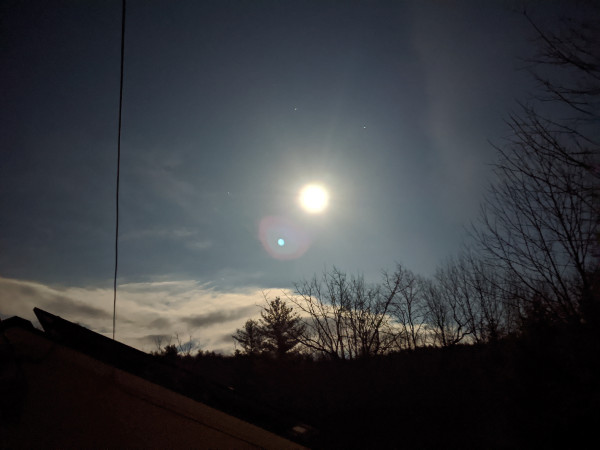
Many people have posted images of the recent Blood Moon. I found its early rising without the dramatic coloring just as interesting as its other hues, for the simple fact of how bright it was.

[November Full Moon, approx. 8:00 pm local VT time shortly after it cleared our eastern hill]
“Which is more important?” runs the old Nasreddin Hodja joke. “The sun or the moon?”
“The moon, because at night we need the light more“.
It can feel that way at night, with the silvery glow emanating from a single point, with both shadow and light more clearly defined than on a hazy summer day, where daylight seems to pour from every quarter of the compass.
So I take this insight or image and run with it. Because that’s what I do, and because I notice that any spiritual practice I undertake regularly soon begins to highlight things in me that “ordinary time”, or the “mundane world”, often leaves hidden. Both flaws and potentials show up like uninvited guests. What I do with them, how they can serve as tools for growth, and not just as props or punctures of the ego, is part of what I make of my particular path. (They’re a gift that keeps on giving, courtesy of a universe that colludes and conspires to dazzle and dismay in equal measure.)
/|\ /|\ /|\
Often the self in such moments of highlighting or contrast resembles the face, the persona, that a Hallowe’en pumpkin presents. (My character is often a caricature of the self.)
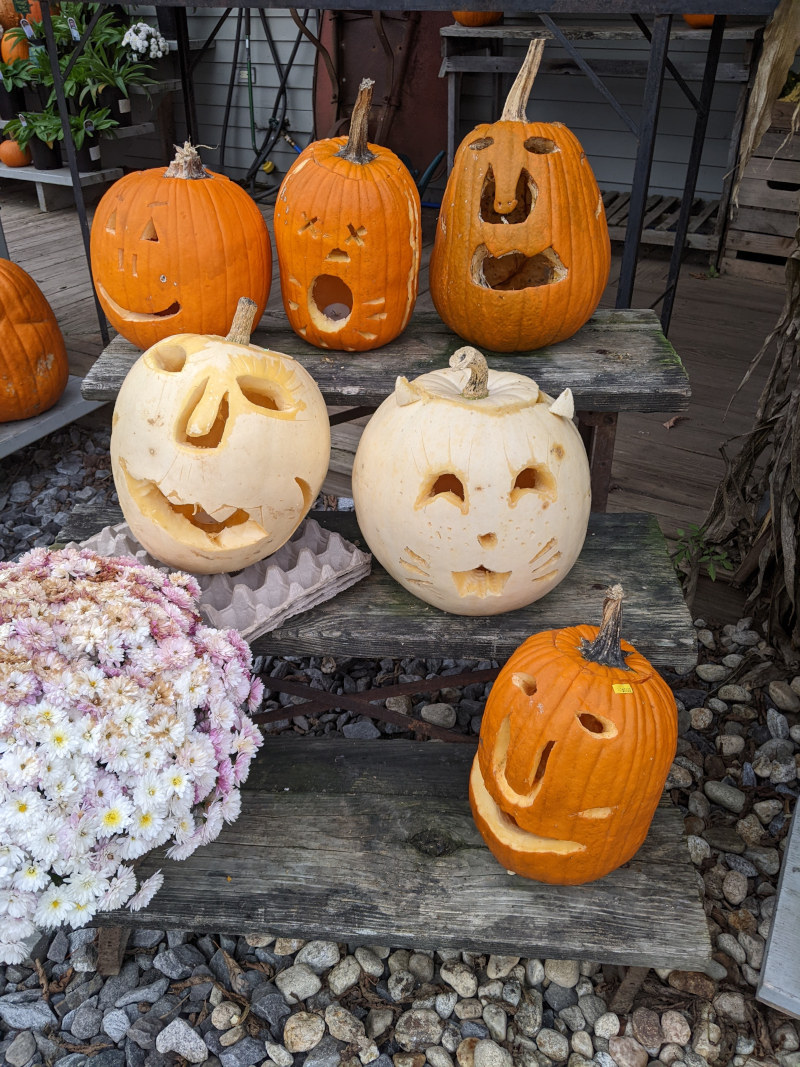
[Pumpkins at Harlow’s farmstand, Westminster, VT]
And I turn to bards, because so often their art confronts them with the self, just as any sustained practice will, and their determination to make something — anything — of that experience, in all its textures, enriches many of us. Robert Frost battled depression and illness in 1933 when he wrote ‘Desert Spaces’, which closes:
They cannot scare me with their empty spaces
Between stars–on stars where no human race is.
I have it in me so much nearer home
To scare myself with my own desert places.
Because this is our human shaping, to measure our lives by our own familiar dimensions, “like one who takes/Everything said as personal to himself”, as Frost writes elsewhere in “The Wood-pile”. And why not? It’s one thing the self is good for, a human scoop to dip into experience and retrieve a day- or life-sized portion of this mortal stuff, this being half-awake and in love with things that keep slipping out of our grasp.
/|\ /|\ /|\
But ffs mister, can’t you just let moons be moons and pumpkins be pumpkins?!
Well, of course. And they will be anyway, in spite of me or anyone else, though I may pile words on them in an effort to wrest them into something for my purposes. “Moon go away I don’t love you no more” writes Jim Simmerman in a poem and collection with the same title. I’ve known days like that, and so have you. But the sheer regularity of full moon, full moon, full moon invites me to linger under the magic sky, wordlessly, or singing a tune I don’t realize I’m humming under my breath.
Earth rhythms move us into their harmonies. Daytime, moon-time, year-time, their slow drum-beat accords with the blood-beat, music we all hear, whenever we listen. And the more I do, the more I want to.
/|\ /|\ /|\
Returns
“True voyage is return” — U. K. LeGuin
After a year away, I’m back with material I hope you’ll continue to find of value. Thank-yous to you who’ve supported this blog, returning to read from over a decade of posts, commenting, encouraging, and recommending articles at A Druid Way to others.
Here we are at another time of festival and holiday, which it pays to remember is ‘holy day’, one set apart from mundane time. The English words holy, Old English halig, and hallow, Old English halga, ‘holy one, saint’ also form a verb halgian, to hallow or make sacred. Hallow evening or Hallowe’en, or All Hallows’ Eve, OE Ealra Halgena Æfen, is in many traditions the first of three days, continuing with All Saints’ Day on Nov. 1 and concluding on All Souls’ Day on Nov. 2. Together the days of the period make up Allhallowtide, a holy time.
It’s a great word we could easily bring back to wider use in contemporary life. What are your hallowtides? If you’re observing Samhain or Halloween alone or with a small group, it’s a great theme for meditation, or a ritual question to ask and answer aloud or silently.
On Friday I drove with a friend to one of Mystic River Grove’s celebrations of Samhain. The crisp air, the almost windless evening, let us feast outdoors before ritual, and the sacred fire warmed us as temps dropped to freezing. “All you who have gone before, please listen now, we are listening too” we sang as we processed into the circle. Third of the ancient Celtic harvest festivals, Samhain is truly ‘summer’s end’, as we turn inward to winter. And as with all things, balance persists, whether we discern it or not: the Southern Hemisphere is cherishing Beltane and its celebration of growing heat and light. This is one of the great challenges of our time, especially as Druids: to find the balance, the hinge point or still center around which events and passions swirl.
* * * * *
With this cycle of the voyage comes a site upgrade, so you can now read without ads.
Third and Fourth Days of Samhain: Spirals and Soundings
[Prelude–1-|-2-|-3&4-|-5-|-6-|-7-|-8-|-9-]
Many years ago now, I participated in an online discussion group that included members of multiple faiths. It wasn’t always a comfortable space, nor did it need to be. We were there for engagement, but not necessarily ease. I recall a sharp criticism of Pagan perspectives on cycles and circles: that a circle is ultimately a cage, a trap, with no escape, and that only a faith that provided an out could offer anything like freedom.
It’s a distinctive view of salvation, or liberation, particularly as a faith rather than a practice. The discussion at the time was also particularly focused on one version of the Goddess as a kind of stand-in for all Pagan belief — a limited perspective the critic brought with him. That is, the (or a) Goddess as immanent, a part of the world, suffering along with mortals, influenced by human actions and wounded by human deeds stemming from ignorance. How, asked the critic, could such a figure ever meet our human hunger for transcendence?
It’s an interesting idea to unpack and explore, rather than simply reacting to. Most traditions have a round of observances, festivals, holidays, and don’t seem to feel bound or constrained by them. I haven’t found Druid practices any different. It’s the combination of the familiar and the new that keeps ritual observances fresh. For that reason, though the circle is a powerful symbol, and a kind of default shape for in-person Druid and other Pagan ritual, the underlying sense I perceive, and another widespread Pagan image, is the spiral. The circle is its two-dimensional version. Energetic movement or potential for movement curls in the spiral, a coil or spring or serpent power. It’s the source of rebirth, regeneration, that ritual glimpses and evokes and embodies. “True voyage is return” indeed, as long as we realize that “everything She touches changes”.
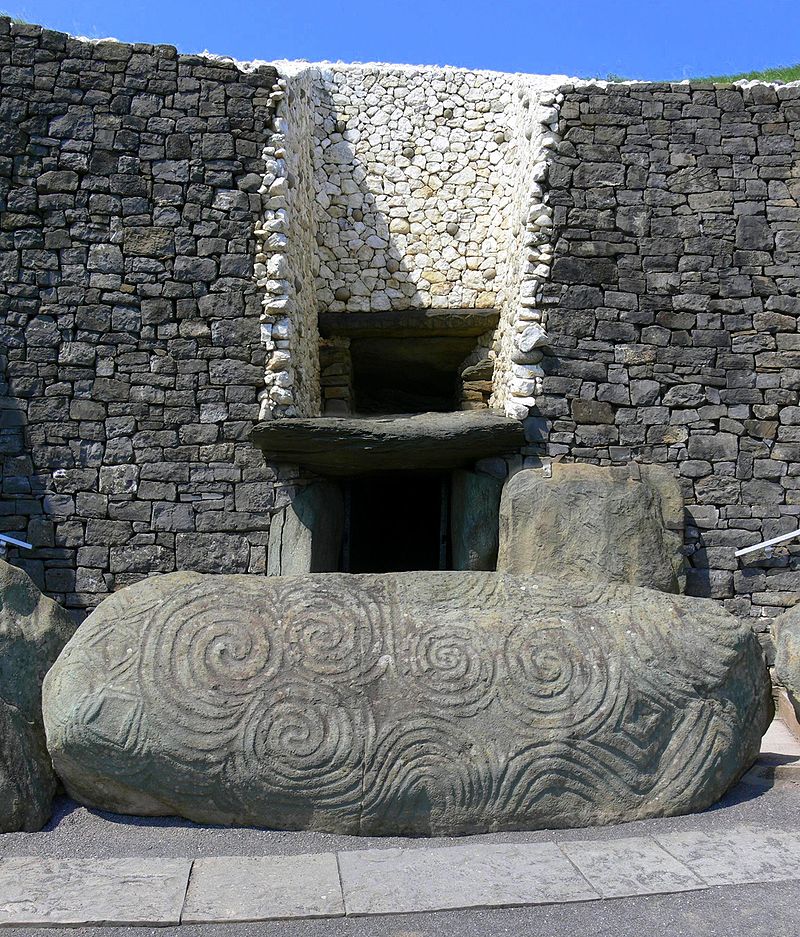
As a meditation object, a “Samhain mandala”, the spiral is potent. Drawing it, tracing or painting it on the body, can work as well for Beltane, for the energies spiraling into summer that are manifesting in whorls and curls of plant tendrils, of the burgeoning natural world, of seashells and spiral galaxies, of the long spiral of death and rebirth. Enter the underworld at Samhain and re-emerge at Beltane every year, practicing the pattern we live, of dying and being reborn. The festivals mirror and echo off each other across the calendar, across the hemispheres. What have I been born from? asks my Beltane self. What am I building right now as I near Samhain that will emerge in the early summer?
Samhain for me is a well. Maybe a well that opens onto the Otherworld, if I choose to dive in. Or sometimes a sea, endless, restless, caressing or lashing our mortal shores. I attempt to sound it, to measure its depth or outlines, to communicate by way of the thin line of attention or ritual or meditation, a line disappearing into the depths toward that which needs to speak with me. I don’t need to worry about missing it: what I do not heed consciously will work its way to the surface regardless.
/|\ /|\ /|\
If there’s one thing I know about the ancestors, it’s that they will be heard. Death has not so enfeebled them that they can only speak one time each year, or only with my attention and respect. Rather, my attention and respect are gifts I can offer, so that ancestral patterns, goals, wisdom can emerge within my circle of intention: I can meet in a circle with my ancestors, as with a spiritual council, and know what is afoot, and whether it aligns with what I am doing now. Not all their long-term projects deserve my assent or participation.
And I also bring assets to the council: present understandings, a body and set of experiences derived from being alive now, with links to the future and my own capacities as ancestor-in-training. For this reason, a mirror is one of my Samhain sacred tools: the face of my ancestors is also mine. I reflect a part of what they accomplished, what survives in this world, what may rest in the earth as a potential for them to manifest, should they return to bodies within this particular ancestral line.
/|\ /|\ /|\
Second Day of Samhain: Nesting
[Prelude–1-|-2-|-3&4-|-5-|-6-|-7-|-8-|-9-]
Our ranch house is small enough to heat easily, but it does sometimes leave us tight for space. Ever since we moved here I’ve made my office in our front entryway, a 7-foot by 6-foot space, with small windows facing north, west and south. It’s cold in winter, but bright enough: even on the most overcast days I can write and read without a lamp. As I started to write this morning, I heard a rustling of birds in the nest above the south-facing door. It’s sheltered by the house to the east, and my entryway-office to the north, and almost every year I hear the peeping of the year’s crop of nestlings. In another hour the sun will hit the nest directly. Some birds still sun themselves there, even now in late October.
Samhain is the start of another kind of nesting season. Beltane is of course a nesting time in more literal ways: birds raising families, and soon enough kicking them out of the nest to get them flying. We nest at Samhain and turn earthy, drowsing, seeking warmth, comfort, richer foods to keep the cold at bay. At Beltane we celebrate the fire in us, and we can do the same at Samhain, especially if we seek more inwardly for the flame. Samhain and Beltane fires differ — you know this in your skin if you’ve observed both holidays in some way more than in your head.
/|\ /|\ /|\
The other path I follow celebrates its new year this weekend, and enters a year of creativity, one in a twelve-year cycle of named years. A year tuned to creativity: we need it, to work through the challenges and opportunities that lie ahead.
/|\ /|\ /|\
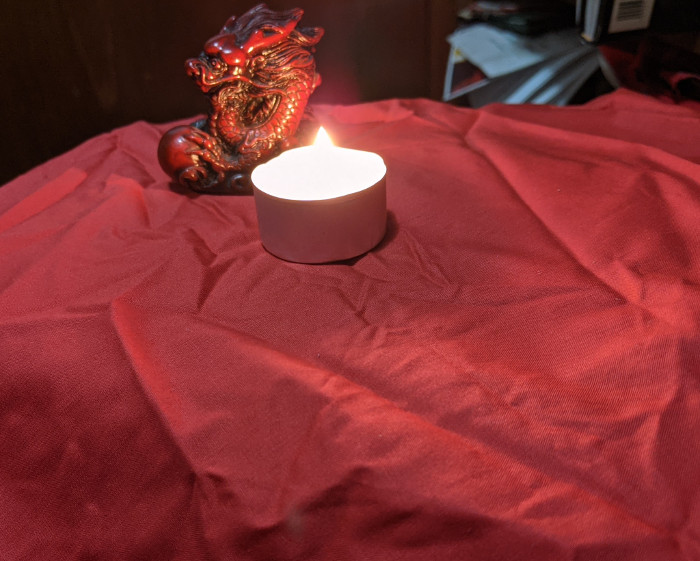
I like Susan’s recent comment: “does our breath with intent to our ancestors give breath to them … hmmm I would like to think so.” I try it out — breathing as a way to connect with those who breathed before me, those whose bodies enabled this body, who made it so it could breathe. One communal shared breathing, the same air: beloved ancestors and I, one large set of lungs among us. We keep the breath going, the ancestral lines, the lines of inspiration, taking in what’s handed down to us, and breathing it into new life and possibility. I breathe with intention as I light my tea light, as our local sunset arrives, and send off this post.
/|\ /|\ /|\
First Day of Samhain: Cardinals
[Prelude–1-|-2-|-3&4-|-5-|-6-|-7-|-8-|-9-]
The stuff of my day
can light me a way
I find myself in a rhyming mode today, and over time I’ve learned to work with it when it comes, because it can often give me light touches and entries and approaches to things that can otherwise be heavy or obscure, or present no handles, no entrance or doorway at all.
On this first Day of Samhain, I’ve lit a small fire in our woodstove. This Saturday’s sunny, but that autumnal nip in the air is real, and the dampness of early morning fog crept into the house. My wife and I were outdoors early and suddenly we were noticing cardinals. Maybe because many of the leaves are already off the trees, we speculated. Maybe it’s easier to spot them. The bright birds match some of the leaves as they darted in and around the trees. Depending on the weather, sometimes they’ll winter over here.
As with dream work, so with blogging: first I have to get words down, a tentative, preliminary, approximate account. If I’ve left off dream study for a while, the direct links between dream and waking consciousness can take some work to revive. (Indirect links never leave us — they filter into reverie, whim, daydream, flashes of intuition and inspiration.) For me, the music of a line or two of verse can help. Other times, reading past dream entries can spark a new dream. I take these into sleep and recall improves, coming sometimes over several days, and slowly, or all at once.
I titled this post “cardinals,” but that’s really a placeholder. The birds aren’t thinking in human words, and “cardinal” evokes the color, which is often more useful than the word itself for many of my purposes. Let me bathe in cardinal red. Words as stepping stones out of our hyper-verbal culture — words simply as light touches, into something other.
/|\ /|\ /|\
Tonight at dusk I’ll set a match to a tea-light and daydream with it. Scrying with flame? Sure. Drawing a tarot card? Possibly. Maybe literally trying my hand at drawing a tarot-like image. Just being alive is itself a kind of divination. Samhain flame links me to a thousand generations. I take air into my lungs, I let it go. O mortal thing, whispers everything else around me, mortal thing, are you listening?
Prelude: Nine Days of Samhain (Beltane) 2021
[Prelude–1-|-2-|-3&4-|-5-|-6-|-7-|-8-|-9-]
Both fire festivals, so fire can feature prominently in both, if you choose.
Nine Days of Beltane? What’s that? Well, go ahead — create it, if only for yourself! Noon for Beltane, dusk for Samhain. Or some other time that fits you and your season.
Often I try to model these things here on this blog, because so much of Druidry is in the doing. I’ll be starting my own Nine Days tomorrow, Saturday — 23-24-25-26-27-28-29-30-31 — ending on the Holy Evening itself, which is after all what Hallowe’en means. I’m posting today, a day before, in case you want to try it out yourself. Or you could start on the 27th, with Samhain/Beltane as the middle day, and continue for four days after for your count of nine. Or try seven days, or five. The point is to make a shape, and then fill it with a practice, with intention, with doing and experiencing and trying on the shape for size and fit, partly to see how well it actually works.
Much has been written recently about how to deal with toxic ancestors (here’s one example). Do a blog search if you need support in that regard. I’m focusing on a few ancestors I specifically choose to remember. As for inviting their presence, if they’re direct blood ancestors, I carry them in me already, in all their messy humanness. And I can make any invitation to a ritual quite specific: to those who wish me well, whom I respect and love, whose legacy deserves acknowledging, whose imprint helps shape me in ways I benefit from. If I need a further reminder, I can look in a mirror. That I’m here at all, I owe to those who came before me, and built this physical form from their own bodies. If it feels right, include a small mirror for the ritual.
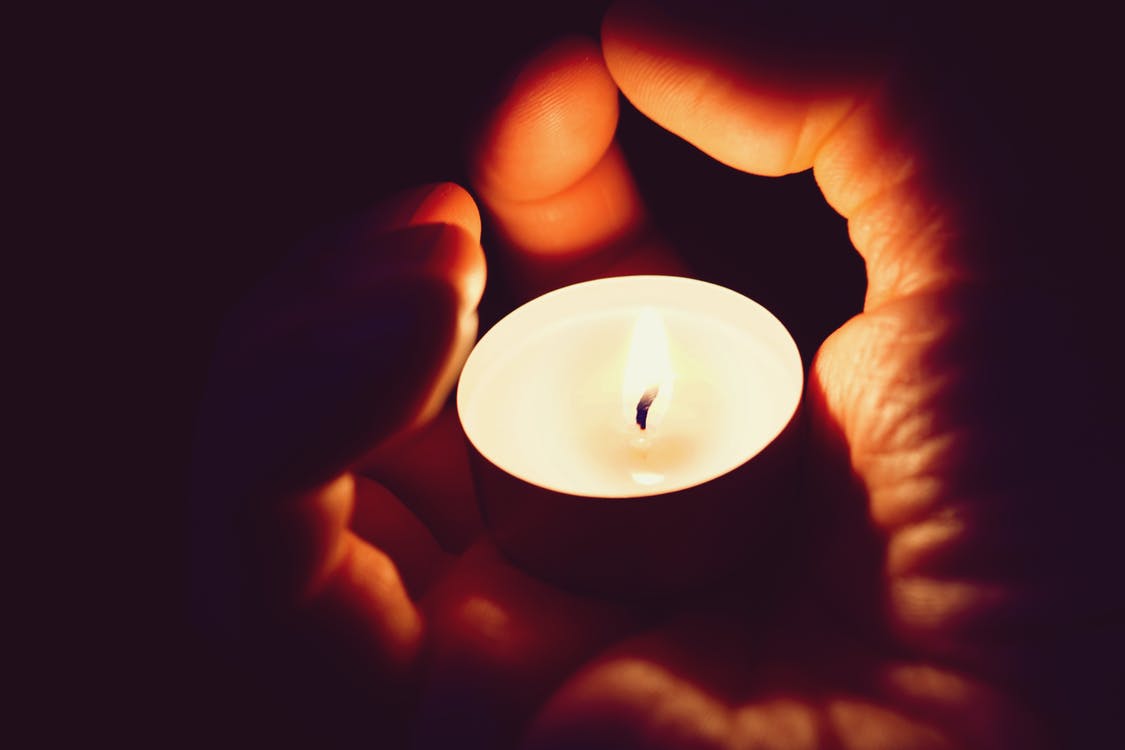
Fire works so well at these times because of the major seasonal shifts occurring — whether into early winter, or early summer. In both cases, fire fits. It signals to the unconscious that something profound is happening, that something elemental is one appropriate response. If I do nothing more each day than light a fire — a candle, a lamp, a blaze in the woodstove or fireplace — and sit in silence for a time with that light, that flame, I am opening a portal for memory and inspiration and deep reflection. As the wisest recipes advise, season to taste.
You might find a star meditation a simple addition. If you’ve investigated ceremonial magic, you’ve likely heard of the rituals of the pentagram, of summoning and banishing forms. Here at these elemental times a full panoply of the Four Elements and Spirit is good to recall, to embody, to honor and enact. With nothing else needed but fire and my own body (“earth my body, water my blood, air my breath and fire my spirit”), I have all I need. Anything I opt to add is a gift, an offering. If I choose, as one part of my simple ritual, I can shape a star in the ethers, the akasha, the astral, drawing it with a forefinger, good as any wand. If I need or choose, I can declare my finger a wand for the purpose of ritual. Or search the day before I start my Days of Samhain for a found object as wand or magical tool. Spirit honors creativity, because we’re doing what It does all the time. We’re awen-izing.
Or I may spend that fire interval of each day’s ritual just journaling. I can mark each entry with a star, or do any other rituals that surround my writing. “Here begins the first day of my fire writing …” and I’m on my way for that day’s entry.
When you start thinking and imagining these things, the ritual also starts taking shape.
/|\ /|\ /|\
Waxing Towards Samhain: Altars Everywhere
You can feel it, can’t you? The approach of the next of the Great Eight festivals, the holy tide of Samhain. Or across the hemispheres, the advent of Brighid’s day of Imbolc. Fire festivals, both of them. Opportunities for a “deep dive” inward, if you so choose.
Or maybe your inner senses just aren’t tuned to such things. Not a problem. Imagine what it feels like, the energies swirling and eddying around this time. Or if you have a photo of a beloved ancestor, or an object which that ancestor once held, you’ve got a different kind of connection.
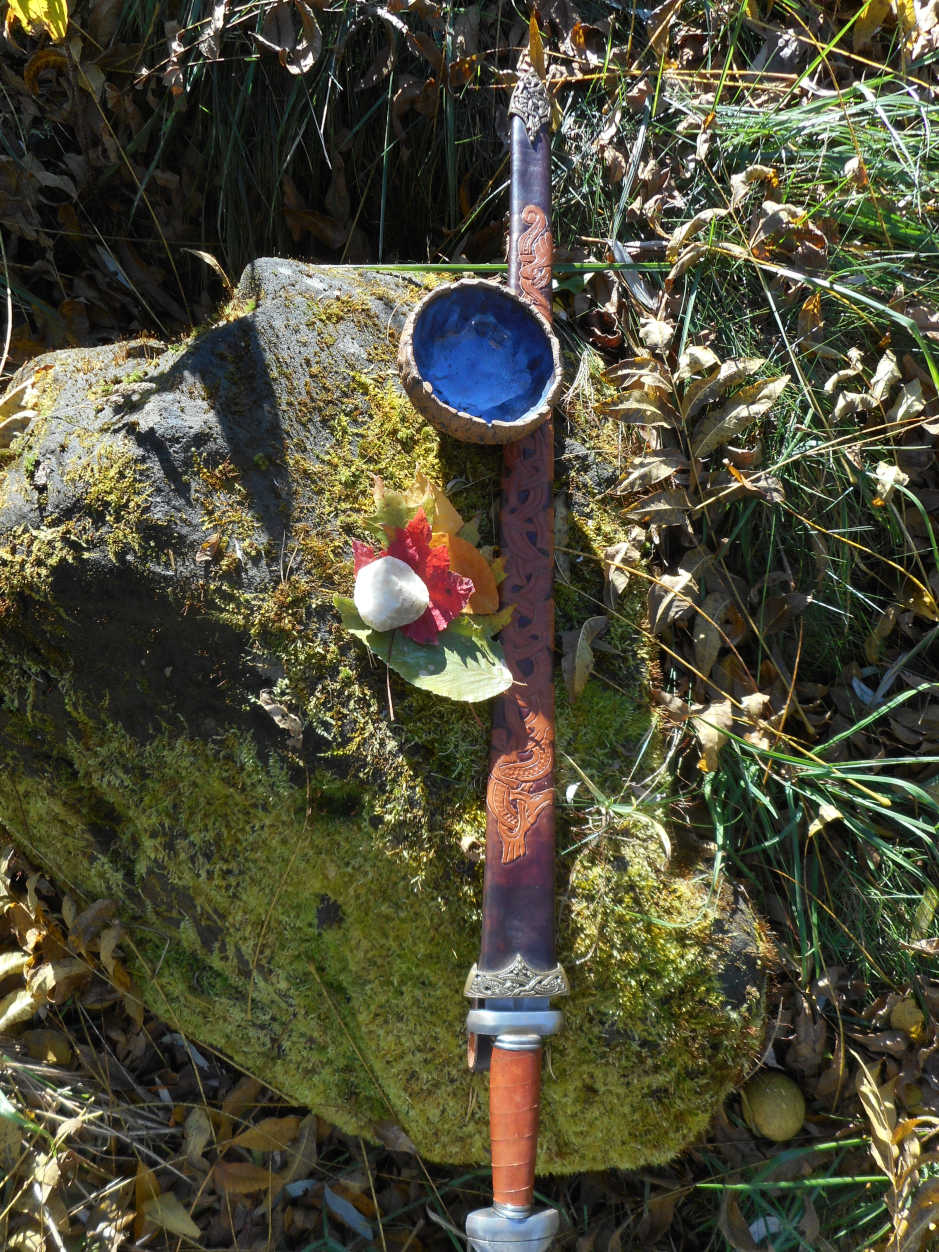
Suggestions for where I can purchase an altar? posted a new Druid on a Druid forum. The responses tended toward the repurposed and well-loved piece of furniture. Discarded, scratched and refurbished, that tabletop, desk, nightstand, shelf. One commenter noted, “Half my house is now an altar” with niches and corners lovingly adorned with figures, stones, feathers, driftwood, sacred objects. The cast-off, hand-me-down, yard sale. And out of doors, the sawn-flat stump in the woods, or the stone the septic company excavated while locating your tank, or the natural crook or niche where a tree-trunk meets the ground.
Those blessed with outdoor space in a yard may have room for a permanent circle, or simply an open patch of grass, or a small corner walled on two sides by fencing, where a small figure peeps through the foliage.
The full moon last night and tonight can be a potent altar, as can the human heart, open and listening. Each ritual we do erects an altar in spirit, leaving an imprint in consciousness we can strengthen and reaffirm each time we bring it to mind, or repeat the ritual, each time we gather again in a beloved circle of Others, whether they have their skins on or not.
/|\ /|\ /|\
Welcome to our newest visitor from Mauritius.
Steps toward Elemental Rebalancing
In the previous post I wrote:
With covid, wildfires, floods and political turmoil, the U.S. exhibits profound imbalances in all four Elements. With air transmission of the virus and a mental haze surrounding our responses, with fire in the west and our over-heated rhetoric, with water leaving its channels in flood and drought, and our emotions swamped, and with stubborn disagreement about whose land this is and how we can best inhabit it together, Druids, we have our work cut out for us.
It was one of those moments when the blindingly obvious actually became visible. We’ve all had those perceptions, and wondered why until now we hadn’t seen them in terms that made their focus clear. And yes, it would be nice to think that a clarified and clarifying perception is all I need to move forward. But as you and I also know, by the time we perceive something clearly, we’ve almost always been working on it for a while already, and we usually stand somewhere around midway on the particular leg of the path we’re walking. The next half of the journey awaits us.
Deborah Lipp writes in her Way of Four Spellbook that Spirit
is what happens when all four elements meet and combine. Spirit is the quintessence, the “fifth essence,” the original elemental whole from which the other elements emerged. Elementals have only their individual qualities. For example, Gnomes will only be Earth, and are incapable of acting in any way but an Earthy way; they won’t feel or be willful. And Salamanders will only and forever be Fire; we cannot ask them to be stable or exercise self-control. But people, and other beings with spirit, have the capacities of all four elements, and the freedom to grow and explore in any direction (pg. 16)
By devoting myself to a particular element, I’ll certainly see results. That’s also how imbalances result: push hard into too much of a good thing and soon I’m no longer in “good thing” territory. We may tend to think that only skilled users of magic obtain results, when almost anyone can and does manifest them — just not especially balanced ones. We’re all magicking ourselves into and out of situations constantly. It just may not be particularly gracefully or intentionally or lovingly.
Lipp notes:
… heavy work in a single element — such as several Earth spells over a period of time unbalanced by other elemental work — might call forth the presence of the appropriate elemental. It is important to pay attention to signs of excessive elemental activity in your life (pg. 19).
We can and should certainly work for elemental balance. Earth, air, fire, water — diet, exercise, staying hydrated, work, routines, “getting enough fresh air”, partners, pastimes, practices — these are almost the definition of the whole ” self-help” genre, the workshops and guides and supplements, the exercises and fixes, the “one-size-fits-all” that almost never does. Balance means something different for each of us.
We’ve all had the experience, too, of a remedy that does work — for a time. Then eventually we need to tinker, adjust, modify, adapt — or yield at last to the need to change, or do a complete overhaul. “People, and other beings with spirit, have the capacities of all four elements, and the freedom to grow and explore in any direction”. We might add that people have the freedom and also the need to grow and explore in any direction.
I’ve found it most helpful to begin with Spirit — because that’s where balance originates. Starting with any other element means I’m guessing that’s where I should work. But it’s different with Spirit. In fact, if I’m looking for a definition of Spirit these days, that works pretty well — “where balance originates”. You can see from that definition that working out its consequences in each of our lives may well take different forms. Your balance isn’t mine, just like your diet isn’t. But your balance is much larger and more encompassing than what you put into your body — than any one element — and we can see common threads and components when we compare our journeys.
What does all of this mean in practical terms?
1. I can take an “elemental inventory”. Where has my attention been recently? Does any particular element seem to dominate my experience, concerns, actions, feelings, thoughts? Is that element one that I need to cultivate and bring into play, or one that’s already present and may need to be scaled back?
2. I can explore a solar and lunar inventory as well. Is there a time in my day that needs attention or love? Are mornings hard to get going? Are evenings lost in fatigue? Has a quick “pick-me-up” started to “put me down” instead? Are there monthly — moon — issues that keep recurring? How can I recognize and address and honor some of the larger cycles in my life? What does my birthday mean to me and bring into awareness? What elemental features does it highlight or emphasize? How about other anniversaries and yearly cycles?
3. What ancestral forces are at work? Ask for insight into ones you might be overlooking. How are you yourself becoming an ancestor as you live your life? We’re all working on it — we hardly waltz into exalted ancestor status just by dropping this physical form in death.
4. What “either-ors” and binaries in your life need a good Druidic ternary or third component to open them up and remove them from a cycle that no longer feels productive? What’s a missing third component? What tensions include an overlooked factor that may clarify and illuminate them? What’s one small thing I can do differently? And what difference does that make?
5. How’s your dream life? Yes, many people think they don’t recall their dreams, and that may well be true, so how is the dream content manifesting in other ways — since it always will? Our hidden lives want to connect with our apparent lives and vice versa, and not be left out or ignored.
6. What numbers or other patterns and dynamics are manifesting in your life? Are you seeing a lot of fives or threes or sixes? These can show up anywhere — odometer reading on your car, dates on the calendar, telephone numbers, billboards, license plates, etc. (I just got a new cell phone number yesterday, and am working out the waking dream of its numeral significance.)
7. What ways and avenues and channels do you have in place in your life for answers to any of these things to reach you? We each develop strategies to cultivate insight and intuition and discovery, and we can each find and explore new ones, too. Maybe you daydream in the shower, or maybe music helps you open up to non-verbal wisdom. Maybe a song lyric or meme reaches you with an insight that resonates. A friend’s casual comment, or a divination your carefully work with. A dream practice, or daily ritual, or fortune cookie. Prayer, meditation, chant. The “chance” detour on your way to somewhere else that brings you a new encounter, road sign, time for reflection, etc.
8. With so much attention on “waking up” and “wake-up calls”, how about some “sleep down” time as well? As one hemisphere of the planet moves deeper into the dark half of the year, even as the other is waking up into spring and summer, how can we use this shifting dynamic that is always taking place in ourselves as well? What parts of us need to make this shift, into rest and restoration, as well as animation and activity? Each hemisphere isn’t one thing only — both these tendencies still manifest. As above, so below; as within, so without.
9. Where (and how, and when) does Spirit manifest in my life? It’s present for everyone, and despite some millennia of bad theology and teaching, Spirit isn’t — or need not be — a matter of “belief”. My stomach digests and my liver purifies my blood without any need for “belief” on my part, thank the gods. Spirit manifests quite as concretely and specifically for each of us, and in ways it pays to seek out and honor and relish.
/|\ /|\ /|\
A Year in Flags
A year ago in October 2020 I added that flag-counter widget to this site, and it’s been illuminating to me to see where you’re from. Not surprisingly, the majority of you hail from somewhere in the English-speaking (and reading) world. But I deeply thank those of you who make the effort to read in what is a second or third language for you.
A blogger appreciates return visitors, but some of you may have followed a link to a particular article, or the passing comment of a friend, and found what you wanted in a single visit.
Beyond where the counter records you, I also know from WordPress analytics which individual posts draw the most visitors. Certainly my blog isn’t “representative of Druidry” in any conscious way, and I write what I darn well please. But in light of those qualities I still try to draw conclusions about how the ideas and inspirations of Druid practice have spread around the planet. So it’s good to see that the countries that would most benefit in making changes in lifestyle and consumption and re-connection to the natural world — challenges Druidry tackles head on — also show up prominently in my readership. And you might extend that further and note that if we “follow the numbers”, the U.S. tops the list and outnumbers any other nation by many times in its need for Druid practice, and the immediate value and applicability and benefit of its ways of living and being in the world.
With covid, wildfires, floods and political turmoil, the U.S. exhibits profound imbalances in all four Elements. With air transmission of the virus and a mental haze surrounding our responses, with fire in the west and our over-heated rhetoric, with water leaving its channels in flood and drought, and our emotions swamped, and with disagreement about whose land this is and how we can best inhabit it together, Druids, we have our work cut out for us.
If we look only at nations with visitors in the triple digits or more, we have in descending order (after the U.S.) the U.K., Canada, Australia, Ireland, Germany, Brazil, Netherlands, France, Italy, India, Spain, Russia, New Zealand and Turkey. I particularly appreciate the opportunity to connect with you because I assume many of you are returnees, and so I’m grateful you find value in what I write here.
/|\ /|\ /|\


 A Druid Way